Maker Marks Through Time: From Workshop Attribution to Studio Identity
Maker marks began as ways to identify an object’s source. Trace how their role shifted, then decide what your own mark should say about your studio.
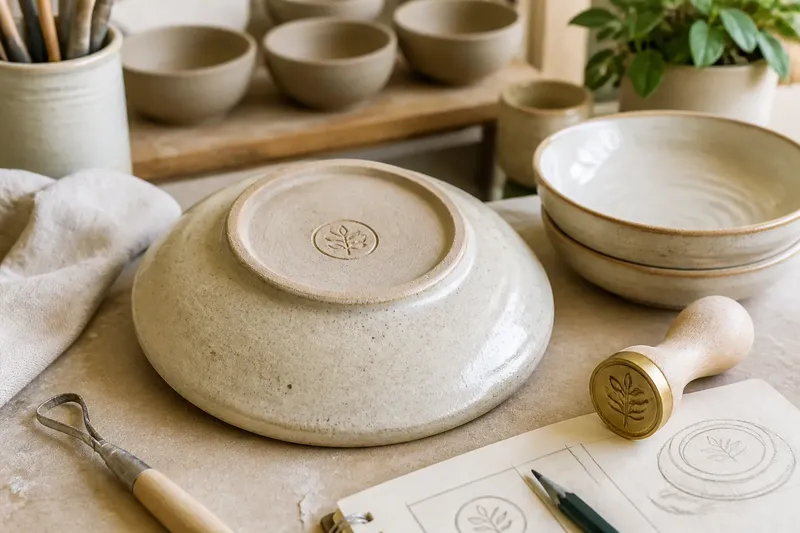
Maker marks tell a buyer where an object’s responsibility or origin is being placed: with a person, a workshop, or a studio. Their history is not a single progression from an old stamp to a modern logo. The surviving marks and their meanings vary across places, periods, and trades, so it is more useful to trace the different kinds of claims they can make than to suggest one universal timeline.
Imagine Lena, a ceramicist beginning work in a shared studio. She wants buyers to know where her bowls come from, but she does not want a mark to imply that she alone handled every stage. That small distinction connects the history of maker marks to a present-day decision: what, exactly, should the mark attribute?
What did maker marks identify in earlier crafts?
A mark on an object can identify its maker, the workshop responsible for its production, or another party connected with its manufacture or sale. Which meaning applies depends on the object and the conventions around it. A stamped name or symbol does not, by itself, establish that one person completed every part of the work.
It is safer to treat maker marks as varied evidence of attribution than as a tidy historical system. In some settings, marks may have been used alongside other signs or records; in others, a mark’s purpose may be uncertain to a later viewer. Without a specific object, place, and period to examine, broad claims about exactly what marks meant would overstate what can be inferred.
The lasting distinction is between identifying an individual and identifying a working operation. A personal signature can point toward an individual’s involvement. A workshop mark can name a shared source without assigning every task to one person. Those claims may overlap, but they are not interchangeable.
How has the role of a maker mark shifted?
For a small venture, a mark can still perform the basic work of attribution: it connects an object to its source. But repeated use across packaging, labels, and listings can also help buyers recognize a body of work. That is a change in function, not proof of a simple historical march from workshop sign to brand.
A studio identity makes a broader claim than a signature alone. It can gather objects under one name while leaving room for collaborators, changing techniques, or different product lines. The accompanying description can then explain who took part and how the work was made.
Lena chooses a studio name for her bowl stamp because the shared studio is part of the production setting. On her listing, she describes her own role and mentions the shared workspace. The mark identifies the venture; the text supplies the detail that the stamp cannot carry.
What should your mark claim about the work?
Start by deciding what the mark is meant to identify, rather than by choosing a visual style. A personal name, a workshop name, and a studio name each point a buyer toward a different source. The most useful option is the one that remains accurate as the work is made and sold.
- Individual attribution: Check whether one maker is responsible for the work in the sense buyers are likely to infer. If so, a personal name may fit; if not, use a studio or workshop name and describe individual roles separately.
- Shared production: Check whether collaborators or shared facilities shape the process. If the mark would imply sole authorship, choose a collective source name; if it would not, retain the personal mark and clarify the shared contribution in the description.
- Where the mark appears: Check whether the object’s surface can take a stamp without obscuring or harming it. If it cannot, put the attribution on a tag or accompanying card; if it can, use the object itself as a direct point of origin.
- How the mark reproduces: Check a sample on the actual material, such as clay, fabric, or paper. If fine detail disappears, simplify the mark; if its essential features remain clear, keep the design.
- What the buyer needs to know: Check whether the name alone explains the source and role of the venture. If it does not, add a concise description to the listing or care card; if it does, avoid adding explanatory language that repeats the same information.
- Room for future work: Check whether the name still fits if the studio adds collaborators or related objects. If it becomes misleading, choose a broader studio identity; if it remains accurate, keep it and distinguish product lines with their descriptions.
What is not worth the effort is inventing an elaborate backstory for a mark before its basic attribution is clear. A symbol does not need a legend to do useful work; it needs to be used consistently and described honestly.
How do you choose between a signature and a studio mark?
Say Lena makes a new run of serving dishes in the shared ceramics studio. She starts with three inputs: the work is hers to design, another studio member helps prepare the clay, and the studio’s kiln is used for firing. First, she asks what buyers should attribute to her personally: the design and finishing. Next, she decides whether a stamp on the dish would imply that she carried out every production task. It might, so she selects the studio name for the underside and writes a short listing that credits her design and finishing while noting the shared production setting. The resulting mark points to the venture, and the listing makes her contribution legible without claiming sole responsibility for the whole process.
This choice does not rule out a personal signature elsewhere. A signature can credit an individual contribution, while a studio mark can identify the source through which the object is presented. The two can coexist when their meanings are clear rather than competing for the same claim.
What do makers ask about attribution marks?
Is a maker mark the same as a signature?
No. A signature usually points to an individual, while a maker mark may identify a person, workshop, or studio. The surrounding description helps buyers understand which meaning is intended.
Can a shared studio use one mark?
Yes, if the mark accurately identifies the studio or venture behind the work. A description can name individual contributors when that context matters.
Does a maker mark need to be a logo?
No. It can be a stamped name, printed text, or another repeatable identifier. Its purpose is attribution; a logo is only one possible form.
Where should a maker mark appear?
It can appear on the object, a label, packaging, or accompanying information. Choose a location that identifies the source without damaging the object or obscuring its intended use.
How can a mark stay accurate as a studio grows?
Review the claim the mark makes whenever the way work is produced changes. If a studio moves from one maker to a shared team, its descriptions may need to name that shift; if the name still accurately identifies the source, the mark itself may not need to change.
Maker marks have served different purposes in different contexts, and a contemporary studio can draw on that distinction without pretending to inherit one fixed tradition. For a small venture, the most useful mark is the one that points to the right source—and leaves the fuller account of the work to the words beside it.