The Polished-Too-Soon Trap in Early Project Descriptions
Early project descriptions become clearer when plain language comes first, helping you expose shaky assumptions, choose a workable format, and polish with purpose.
You can spend an afternoon refining the description of a creative venture and still be unable to decide what to make next. A plain-language project description is useful for a different reason than explaining an offer: it can expose the choices you have not made yet.
How can a plain description reveal the decisions still open?
Write down the project as it stands, including its current format, materials, and limits. Treat each noun as a commitment to examine, not a promise to customers. A polished phrase often blends several possible directions into one pleasing impression; an unadorned sentence makes those alternatives easier to see.
For instance, “a thoughtful experience for creative renewal” could refer to a guided drawing session, a printed prompt deck, or a weekend gathering. Those are not just different ways of describing one idea. They require different preparation, settings, and forms of participation.
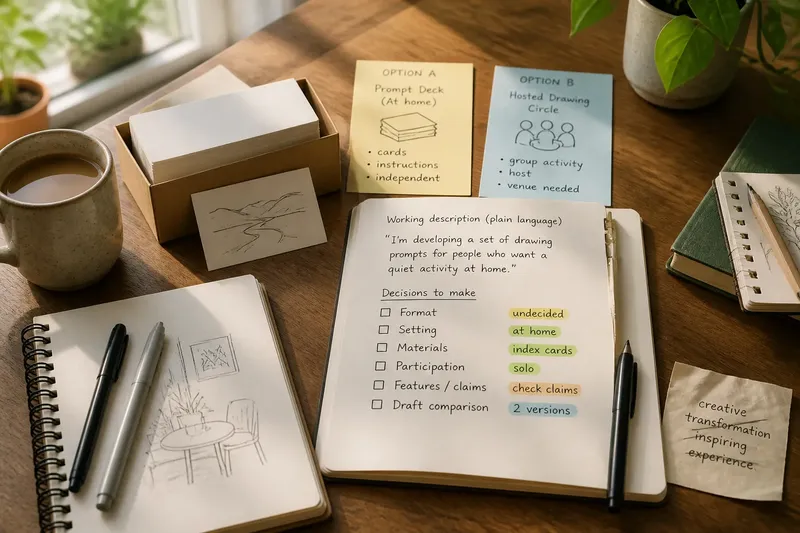
Try replacing an abstract phrase with a working statement about what you might make or arrange. Mark the parts that are still undecided: “I’m developing a set of drawing prompts for people who want a quiet activity at home.” The statement does not settle every detail, but it shows that format and setting are already shaping the concept.
What does plain language do that polished copy cannot?
Plain language is a thinking surface. It lets you compare versions of an idea without first choosing a tone, tagline, or visual identity. When the wording is simple, a change from “prompt deck” to “guided session” is visible as a change in the work itself.
Polished language has another job: it can give a settled direction a recognizable voice. It may convey playfulness, restraint, or intimacy once you know which experience you are describing. But smooth phrasing can make unresolved options seem more consistent than they are.
That distinction matters when you are deciding what to develop. If two drafts sound equally compelling but imply different materials or ways of taking part, compare those practical demands first. The choice is about the shape of the venture, not which sentence has the better rhythm.
How do you turn a draft into a useful decision?
Use the draft to identify what needs choosing, then record the evidence you already have and what remains an assumption. A short decision list can keep the process grounded:
- Check whether the format is named; if it is a deck, plan the work around cards, and if it is a session, outline the activity instead.
- Check whether the setting is specified; if people will use it at home, consider independent instructions, and if it requires a shared space, plan for a host and venue.
- Check whether the materials are known; if the concept depends on a particular material, draft around it, and if that choice is unresolved, compare suitable options before writing a firm description.
- Check whether participation is clear; if a person can use the project alone, describe that path, and if guidance is needed, decide who provides it and how.
- Check whether a phrase implies a feature you have not planned; if you can name the feature, keep the claim, and if you cannot, remove or soften it.
- Check whether two drafts describe the same work; if their formats and activities match, refine the voice, and if they differ, choose which direction to develop before polishing either one.
Say you have notes for both a prompt deck and a small hosted drawing circle. Your starting inputs are a draft that mentions “guided drawing,” a box of blank index cards, and no venue or hosting plan. You mark the format as undecided, note that the cards suit a take-home activity, and notice that “hosted” would require a person and a place you have not arranged. You then write two plain versions: one describes cards with instructions for drawing at home; the other describes a scheduled group activity. The resulting decision is to develop the card format first, because its materials are already part of the idea and it does not depend on an unplanned venue. That is a choice about what to explore next, not proof that the other format is wrong.
When should you polish an early project description?
Polish the description after you have chosen the direction it represents. Keep the working draft nearby and compare the revised wording against its specific details: format, materials, setting, and participation. If a graceful phrase erases one of those details, restore the information or reconsider whether the phrase is doing useful work.
For a take-home prompt deck, a warmer description might mention drawing at the kitchen table or working through a prompt during a quiet break. Those details can add character while staying tied to the concept. A promise of “creative transformation,” by contrast, suggests an outcome that the project may not be able to explain.
It is not worth refining a tagline while you are still choosing between a product and an event. Keep one plain working description and spend the effort on the open decision that would change the actual work.
Which questions help you make the next decision?
What part of the concept is still undecided?
Look for words such as “experience,” “community,” or “creative renewal” that could cover several formats. Replace each with the concrete alternatives you are considering, then decide which one you are ready to develop.
Does the draft commit you to a format?
Check whether the sentence points to an object, service, gathering, or activity. If it quietly mixes more than one, split the possibilities into separate working descriptions before choosing a voice.
Which details would change the work itself?
Materials, setting, preparation, and the role of a host can all alter what you need to make. If a detail changes the project’s demands, resolve it before treating the description as finished copy.
What is not worth polishing yet?
A slogan or mood-setting adjective can wait if the format and activity remain unsettled. Keep the simplest accurate wording for now, and return to style when you can point to the specific project it should express.
How should the description evolve with the project?
Revise the working description when a real decision changes the concept. If a planned group activity becomes a set of self-guided cards, change the format and participation details; do not merely replace one adjective with a livelier one. The plain version should track the project as it develops.
A polished version can sit beside it once the direction is clear. The two versions need not sound alike, but they should point to the same work. If one describes a hosted gathering and the other a take-home object, the mismatch is a prompt to revisit the decision, not a copywriting problem.
A plain project description is most useful when it helps you choose what to make, arrange, or leave aside. Keep it close to your working notes, and let its unresolved words point toward the next practical decision. When the choices settle, the language can become more expressive without hiding how the project is built.