The One-Sentence Test for a New Venture Idea
Use the one-sentence test for a new venture idea to connect a specific audience, need, and offer—and see what to clarify before you build.

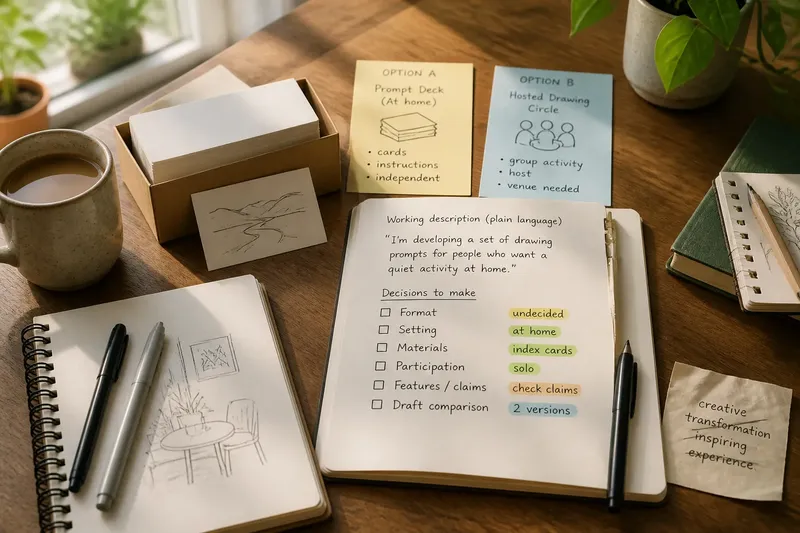
You can describe your idea as a handmade notebook, a workshop, and a set of prompts, but that list does not yet tell you what to make first. The one-sentence test for a new venture idea connects one audience, one recognizable need, and one concrete offer so you can see where the concept still relies on guesswork.
This is not a slogan exercise. The sentence is a private working description, useful when deciding what belongs in an early version and what can wait. Its value is not that it makes an idea sound persuasive; it makes the relationship between its parts easier to inspect.
What should the sentence help you decide?
A useful sentence helps you distinguish a coherent starting offer from a loose bundle of possibilities. Try this structure: “For [person in a particular situation] who [wants to do or resolve something], [project] offers [a specific product, service, or experience].”
You do not need to keep the wording. Keep the three decisions it exposes:
- Audience: If you can name only a broad group such as “creative people,” then describe the situation or task that makes the idea relevant; if several distinct groups remain, write a separate version for each.
- Need: If the need is a general feeling such as “more inspiration,” then name an action or moment; if you cannot do that yet, record the missing detail as a question rather than presenting it as known.
- Offer: If the offer sounds like a mood, such as “a fresh experience,” then name what someone receives or does; if its form is undecided, state the current draft plainly.
- Fit: If the audience, need, and offer do not plausibly connect, then revise the mismatched part; if the connection still depends on an assumption, write down what you need to clarify.
- Scope: If the sentence lists multiple products or services, then choose one initial offer; if the alternatives solve different needs, keep them as separate concepts rather than squeezing them together.
- Evidence: If a claim about what people want comes only from your own guess, then label it as an assumption; if you have relevant conversations or inquiries, use their actual context without treating a few remarks as universal demand.
The checks are not a scorecard. They help you notice whether you have made a choice, described an assumption, or left a decision open.
How specific should the audience be?
“Anyone who likes handmade goods” includes people with different routines, tastes, and reasons for buying. A more useful audience description identifies a shared situation: a person who wants a pocket notebook for quick sketches while waiting between appointments, for instance. That detail gives you something to ask about without pretending to know the person’s whole life.
Use what you can observe in conversations, inquiries, or the place where you hope to offer the work. If you have no basis for choosing among possible audiences, keep the choice provisional. A narrow guess is still a guess, and a broad label does not become informative simply because it sounds welcoming.
How can you make the need and offer concrete?
A need becomes easier to evaluate when it names a task or moment. “Wants to make more art” might become “wants a low-pressure way to start drawing after work.” The second version does not establish that people will seek your offer; it gives you a clearer situation to examine.
Then name the offer in terms someone could picture. A printed prompt deck, a visible-mending session, and a beginner’s printmaking class are more concrete than “creative support.” Specific nouns also expose decisions you may have postponed, such as whether an offer is a physical object, instruction, or time spent making something with others.
It can help to consider what someone already does in that moment. They may use a phone note, borrow a library book, or make do with an ordinary notebook. Those alternatives are context, not obstacles you need to dismiss. Your sentence should make clear what you are proposing, not claim that it is better for everyone.
What should you do when the parts do not fit?
Check the links between the three parts rather than polishing the whole sentence. An audience seeking quiet, focused work may not fit an open-ended group event; a need for quick reference may not fit a long course. The mismatch may mean the offer should change, or that you have combined two different concepts.
- Mark the audience. If the label does not reveal a relevant situation, replace it with a task, context, or constraint; if you lack a basis for choosing, mark the audience as provisional.
- State the need. If it names only a mood, rewrite it as something the person wants to do, make, learn, or resolve; if that detail is unknown, write the question you need to answer.
- Name the offer. If it describes an impression rather than something tangible or participatory, specify the object, service, session, or experience; if the format is still in draft, say so.
- Read the links aloud. If the audience could plausibly have the need and the offer responds to it, keep the connection; if not, revise the part that conflicts instead of adding more explanation.
- Separate alternatives. If two versions serve different needs, give each its own sentence; if they differ only in wording, keep the clearer version and set aside the rest.
- Record the open question. If an assumption remains, write it down beside the sentence; if nothing material remains open, use the description to guide the next choice about what to make or explain.
Imagine you are considering a weekend collage session and begin with the draft, “For people who want more creativity, I offer an inspiring workshop.” You change the audience to adults looking for an easy way to begin making collages, and the offer to a relaxed session with paper, glue, and guided prompts. Reading it aloud reveals that the need and activity fit, but the reason to choose a group session over making collages alone remains unclear. You write that as the next question, rather than adding “welcoming” or “transformative” to the sentence. The resulting tradeoff is clear: the offer is easier to picture, but its particular appeal still needs clarification.
What is not worth the effort yet is spending an afternoon searching for the perfect verb, forcing the sentence into a character limit, or adding a mission statement to make it sound important. Those refinements do not resolve uncertainty about the audience, need, or offer.
What do people ask about the one-sentence test?
Does the sentence need to sound catchy?
No. Aim for a description that helps you make a choice. If it later becomes useful in a shop description or pitch, adapt it then for that purpose.
What if the idea serves several audiences?
Write a separate sentence for each audience and compare the need and offer in each. If the versions describe meaningfully different projects, choose one to examine first rather than blending them into a vague promise.
Can the offer still be in draft form?
Yes. Describe the current form honestly, such as “a draft set of prompts for beginner gardeners.” That is clearer than implying a finished product while you are still deciding what belongs in it.
When should you revise the sentence?
Revise it when a meaningful choice changes: the intended audience, the need, or the form of the offer. Repeated edits that alter only the tone may not answer a new question.
How do you use the sentence without overtrusting it?
A clear description does not establish that people will pay, participate, or return. It is a compact account of your current thinking, not a substitute for learning from the people you hope to serve. Keep it where you make decisions about what to create, explain, or set aside.
When a new possibility comes along, compare it with the audience, need, and offer you have named. If it fits, you should be able to explain the connection in ordinary words. If it changes the concept, revise the sentence and keep the changed choice visible: the one-sentence test for a new venture idea is most useful when it records what you have decided and what still needs clarification.